Healthy Hobbies
![]() ChatGPT Image Jan 20, 2026, 10_11_06 AM |
|---|
![]() ChatGPT Image Jan 20, 2026, 09_58_16 AM |
![]() ChatGPT Image Jan 20, 2026, 10_03_41 AM |
![]() ChatGPT Image Jan 20, 2026, 10_03_38 AM |
![]() ChatGPT Image Jan 20, 2026, 10_06_18 AM |
![]() ChatGPT Image Jan 20, 2026, 10_08_47 AM |
![]() ChatGPT Image Jan 20, 2026, 09_56_42 AM |
![]() ChatGPT Image Jan 20, 2026, 10_25_44 AM |
![]() ChatGPT Image Jan 20, 2026, 10_31_01 AM |
![]() ChatGPT Image Jan 20, 2026, 10_33_22 AM |
![]() ChatGPT Image Jan 20, 2026, 10_28_43 AM |
![]() ChatGPT Image Jan 20, 2026, 10_13_35 AM |
![]() ChatGPT Image Jan 20, 2026, 10_17_34 AM |
Hobbies are voluntary, enjoyable activities that engage the mind and body without pressure to perform, produce, or compete.
​
In health, hobbies are not distractions — they are regulatory tools.
​
They support the nervous system by:
​
-Shifting the body out of constant output and productivity
-Providing moments of presence, creativity, and pleasure
-Reducing chronic stress and mental overload
-Supporting emotional expression and cognitive health
-Creating rhythm, meaning, and internal safety in daily life
Hobbies & Healing
Healing is not only driven by what we remove or improve — it is also shaped by what we allow and enjoy. ​ ​Hobbies matter for healing because they create biological conditions the body needs in order to repair, regulate, and restore. ​ When we engage in wholesome activities we genuinely enjoy — without pressure, performance, or outcome — the body shifts into a state of safety and ease. In this state: ​ -Stress hormones decrease -Nervous system tone softens -Blood flow improves -Digestion and immune activity function more efficiently -The brain enters states associated with learning, creativity, and emotional processing ​ These changes are not psychological only — they are physiological. In a body that is constantly rushed, tense, or overstimulated, healing processes are limited. In a body that regularly experiences calm, joy, and presence, healing becomes biologically possible. ​ Hobbies create internal safety, and internal safety is a prerequisite for repair. ​ This is why hobbies are not optional extras in a healing lifestyle — they are foundational support for resilience, recovery, and long-term health.
Hobby Categories for Healing & Regulation
These categories are not about productivity or performance.
They are about creating internal conditions that support nervous system safety, circulation, emotional processing, and repair.

Sensory Hobbies
Focus: Nervous system regulation, vagal tone, stress recovery
​
These hobbies work directly through the senses to create calm, grounding, and safety.
​
These hobbies support:
​
-
Vagus nerve activation
-
Cortisol reduction
-
Body-based soothing
-
Emotional regulation
​
Examples:
-
Gardening
-
Cooking or baking
-
Scent-based hobbies (essential oils, candles)
-
Warm baths or foot soaks
-
Tea rituals
-
Hand massage or self-care routines
​
Why it matters:
The nervous system reads sensory input as safety or threat.
Gentle sensory input tells the body it is safe to rest and repair.
Creative Hobbies
Focus: Brain health, emotional regulation, nervous system tone
​
Creative expression helps shift the brain out of threat-based thinking and into integrative, flexible states.
​
These hobbies support:
​
-
Dopamine and serotonin balance
-
Emotional processing
-
Cognitive resilience
-
Parasympathetic activation
Examples:
-
Painting or drawing
-
Journaling or poetry
-
Music (listening or playing)
-
Crafting (knitting, pottery, scrapbooking)
-
Photography
-
Digital design or writing
Why it matters:
Creativity reduces chronic stress signaling and supports emotional and neurological repair.
Nature-Based Hobbies
Focus: Stress reduction, immune function, circadian rhythm
​​
Time in natural environments recalibrates stress hormones and circadian signaling.
These hobbies support:
​
-
Lower cortisol
-
Improved sleep timing
-
Immune regulation
-
Emotional well-being
Examples:
-
Hiking
-
Beach walks
-
Forest walks
-
Birdwatching
-
Outdoor journaling
-
Gardening
Why it matters:
Nature provides light, air, rhythm, and grounding — all foundational biological inputs.
Rhythmic & Repetitive Hobbies
Focus: Circadian rhythm, nervous system stability, emotional grounding
​​
Repetitive, predictable movement and actions stabilize nervous system signaling.
These hobbies support:
​
-
Internal timing systems
-
Stress resilience
-
Emotional grounding
-
Regulation after overstimulation​
Examples:
-
Walking
-
Light cycling
-
Knitting
-
Folding laundry mindfully
-
Gentle stretching
-
Tai chi or qigong
Why it matters:
Rhythm tells the nervous system what to expect — which increases safety and regulation.
Social & Connection-Based Hobbies
Focus: Oxytocin, emotional health, nervous system safety
​
Safe social interaction reduces isolation-driven stress signaling.
These hobbies support:
​
-
Emotional resilience
-
Immune function
-
Hormonal balance
-
Nervous system co-regulation
Examples:
-
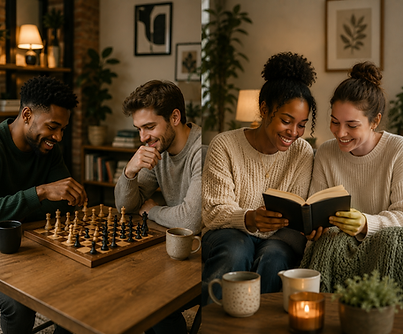
Game nights
-
Book clubs
-
Cooking with friends
-
Support groups
-
Volunteer work
-
Shared creative projects
Why it matters:
Humans regulate each other’s nervous systems.
Connection creates safety signals that directly support healing.
Purposeful & Skill-Building hobbies
Focus: Dopamine balance, cognitive health, self-efficacy
​
These hobbies build confidence and a sense of agency.
​
These hobbies support:
​
-
Motivation pathways
-
Brain plasticity
-
Stress resilience
-
Emotional stability
-
​
Examples:
-
Learning a new language
-
Learning an instrument
-
DIY projects
-
Home organization projects
-
Skill classes
-
Educational hobbies
Why it matters:
Feeling capable and engaged supports neurological resilience and emotional well-being.